If you've ever created video content for your business, you know the real work starts after you hit the stop-recording button. The filming part is often fun, but the editing? That's where the hours disappear. This is precisely the problem that AI video editing was built to solve for businesses and creators. It takes on the repetitive, soul-crushing tasks, freeing you up to think about the big picture instead of getting lost in the weeds.
This guide is all about showing you how tools like Tubentum provide a straight line from production headaches to consistent, high-quality business video content that drives results.
Your New Co-Editor: AI in Modern Video Production
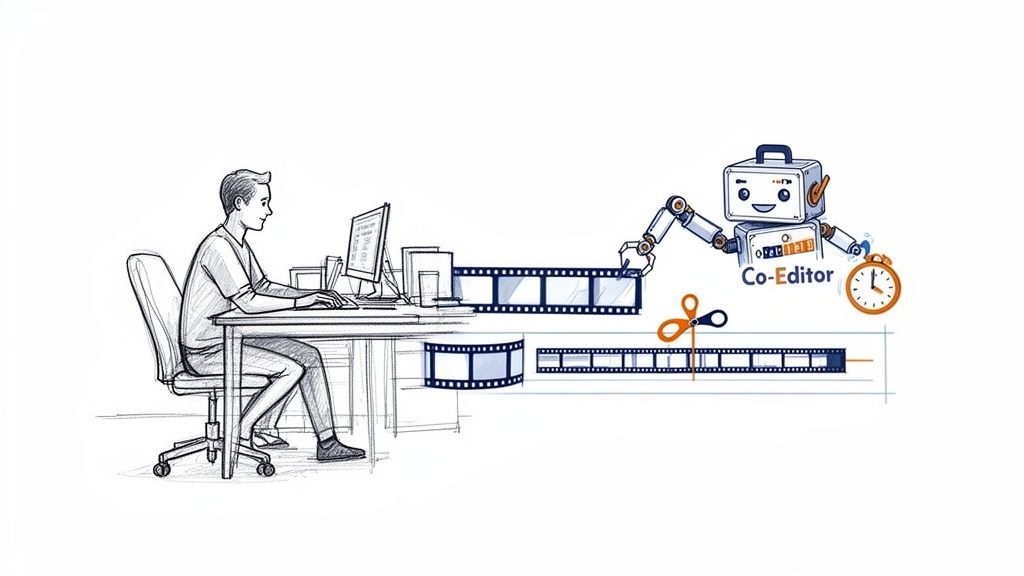
For most businesses and creators, the chasm between having a great recording and a polished, published video is filled with monotonous work. You have to manually snip out every awkward silence, listen back a dozen times to cut filler words, and then spend even more time creating accurate captions. A simple 20-minute marketing or training video can easily turn into a full day of tedious clicking and dragging.
This old way of doing things isn't just slow—it's the single biggest obstacle to producing content at scale.
Think of it like this: traditional editing is like trying to build a deck with a handsaw and a screwdriver. You can get it done, but it’s going to take a long time and a whole lot of muscle. AI video editing, on the other hand, is like showing up with a full set of power tools. You get a professional result, but in a fraction of the time and with far less effort. Tubentum is that set of power tools, designed specifically for business video needs.
To see just how different the workflows are, here's a quick side-by-side look.
Traditional Editing vs AI-Powered Editing
| Editing Task | Traditional Method (Manual Effort) | AI-Powered Method (e.g., Tubentum) |
|---|---|---|
| Removing Filler Words | Manually listen, identify each "um," "ah," or "like," and make precise cuts. | Tubentum's AI automatically detects and removes all filler words in a single click. |
| Cutting Pauses/Dead Air | Scrub through the entire timeline, find silent gaps, and manually trim them. | Tubentum's one-click function finds and deletes all silent segments instantly. |
| Creating Captions | Type out every word by hand or use a slow, often inaccurate transcription service. | AI generates a highly accurate, time-synced transcript and captions in minutes. |
| Making Jump Cuts | Identify places to cut, slice the clip, and repeat dozens of times for a dynamic feel. | Tubentum's AI can automatically create jump cuts based on the transcript to keep the pace engaging. |
This table really highlights the core difference: manual labor versus smart automation, making Tubentum the shortcut to a polished final product.
Shifting from Manual Labor to Creative Strategy
The real magic of AI in video editing isn't just about speed; it's about what you do with the time you get back. When you're not bogged down in the mechanics, your brain is free to focus on what actually grows your audience and your business: crafting a compelling story and refining your message.
This is where a tool like Tubentum steps in to become your new co-editor. It’s an intelligent assistant that handles the grunt work, letting you direct the creative vision from a much higher level.
By automating the groundwork, AI empowers you to move from being a simple video technician to a content strategist, focusing on the message that drives your business forward.
Imagine this: with just a few clicks in Tubentum, every "um" and "ah" vanishes, perfect subtitles appear, and all the dead air is gone—without you ever touching the timeline. This isn't some far-off future; it's what AI-powered editing delivers right now. The goal is simple: produce more professional business video content, faster. Let's dig into exactly how that works.
How AI Understands and Edits Your Content
To really get why AI video editing is so effective for business content, it helps to peek behind the curtain. This isn’t some black-box magic making random guesses. It’s a combination of smart, specialized technologies working together to interpret your content with surprising accuracy, almost like a human editor would.
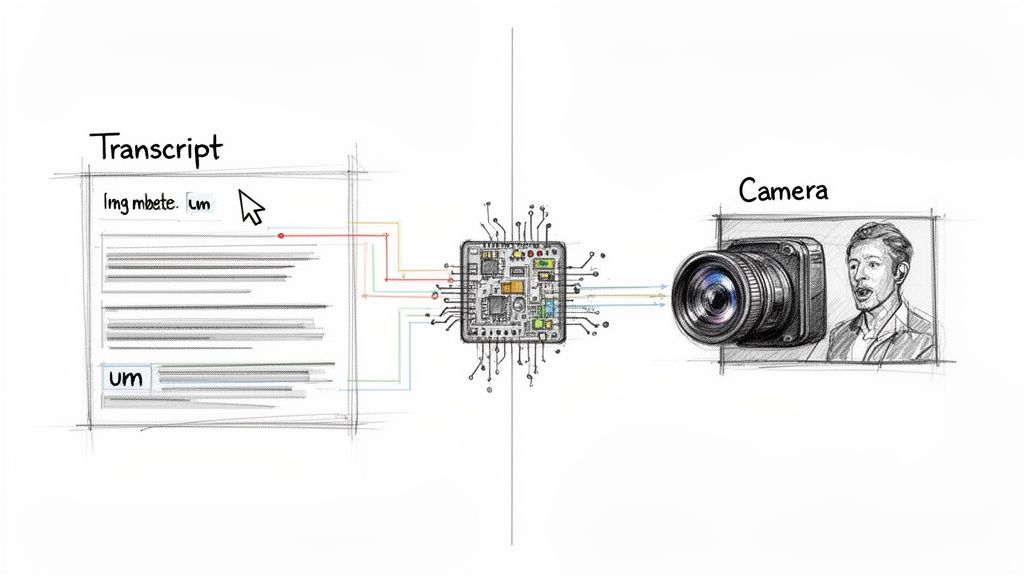
At its heart, the AI uses two key senses to work through your raw footage. Think of one as its "ears," listening to and understanding everything you say. The other acts as its "eyes," seeing all the visual cues on screen. When you put them together, complex editing tasks become simple, automated actions.
This dual-system approach is what frees you from the old-school editing timeline, letting you shape your video in a way that feels far more intuitive—especially for talking-head, corporate, and educational videos.
The AI's Ears: Natural Language Processing
First up is Natural Language Processing (NLP). This is the technology that gives the AI its ability to listen, transcribe, and actually understand human speech. When you drop a video into a tool like Tubentum, the AI immediately transcribes every word you spoke into a text document.
That transcript becomes your new editing playground. Instead of scrubbing through audio waveforms to find that one awkward pause or filler word, you just scan the text.
Editing your video becomes as straightforward as editing a Word document. When you delete the word "um" from the text, Tubentum automatically removes the corresponding segment from the video timeline.
This text-based method completely changes the game for creators and businesses. It knocks down the technical hurdles of timeline editing and lets you concentrate on your message and delivery. If a sentence doesn't sound right, you just highlight and delete it from the script, and the video instantly syncs up.
The AI's Eyes: Computer Vision
While NLP is handling the audio, Computer Vision takes care of the visuals. This technology lets the AI "see" and analyze the individual frames in your video. It can pick out crucial visual details that are essential for making your content look polished and professional. If you want to go deeper into how AI handles video data, looking into topics like AI and automatic video compression offers some great related insights.
For business creators, Computer Vision is behind some incredibly helpful features like those found in Tubentum:
- Speaker Detection: It knows who is talking, which is a lifesaver for editing interviews, webinars, or podcasts with multiple speakers.
- Scene and Cut Detection: The AI automatically identifies natural cuts or shifts in a scene, making it easy to add branded overlays or create dynamic edits.
- Intelligent Reframing: It finds the main subject (that’s you!) and keeps you perfectly in frame when you need to turn a horizontal video into a vertical one for social media marketing.
By marrying NLP and Computer Vision, platforms like Tubentum deliver a remarkably smooth editing workflow. The AI hears what you say and sees what you do, allowing it to handle edits that used to take hours of tedious, manual effort. This powerful duo is your shortcut to creating high-quality business videos faster than ever before.
Why AI Video Editing Makes Business Sense

The tech behind ai editing video is certainly impressive, but let's get down to what really matters for any business: what does it do for my bottom line? At the end of the day, it’s all about tangible results that affect your resources, brand, and ability to grow. We're talking about shifting video production from a creative headache into a predictable, efficient part of your marketing and communications strategy.
The first and most obvious win is a massive reduction in time and money. Manually editing a talking-head video for a course, a marketing campaign, or internal training is a grind. It eats up hours, and for a business, those hours translate directly into dollars spent on production. When you automate this work with a tool like Tubentum, your team gets more done in less time, which sends your content return on investment (ROI) through the roof.
This isn’t just about saving a few minutes here and there. Some studies have shown that AI can cut editing time by as much as 50% and reduce human errors by 35%. Those are serious gains that really add up, as you can explore in these video editing statistics and their impact.
From Bottleneck to Growth Engine
Let's be honest: for most businesses, video editing is the single biggest bottleneck holding back their content strategy. You might have brilliant ideas and fantastic speakers, but if every single video takes eight hours to edit, you’re naturally going to have a ceiling on your output. AI shatters that ceiling.
It turns your content workflow from a slow drip into a powerful growth engine.
Imagine going from one polished marketing video a week to five—without hiring more editors or pushing your current team to the brink of burnout. That’s the kind of scalability AI tools like Tubentum bring to the table. Suddenly, you're able to:
- Test more content ideas to figure out what your audience truly loves.
- Keep a steady presence across all your platforms without the extra sweat.
- Jump on market trends with timely video content while it's still relevant.
This ability to scale your video production is a massive competitive advantage. It lets you become the go-to source in your niche with a constant stream of high-quality content, while your competitors are still stuck wrestling with their first edit.
Ensuring Ironclad Brand Consistency
Beyond sheer speed, AI also delivers a level of brand consistency that's tough to get right manually, especially if you have multiple people creating content. A uniform look and feel—from your logos and lower thirds to specific color palettes—is absolutely essential for building a recognizable brand.
AI-driven platforms like Tubentum can automate the application of your brand kit to every single video, ensuring every piece of content perfectly aligns with your established visual identity.
With a tool like Tubentum, you just set up your branding preferences one time. After that, the AI automatically applies your logos, fonts, and color schemes to every project. This eliminates the risk of human error and frees your team from the tedious, repetitive task of branding video after video. You can see how this fits into a bigger picture in our guide on how to automate content creation.
When you look at it this way, the business case for AI video editing is a no-brainer. It's a direct route to producing more content, at a higher and more consistent quality, in a fraction of the time. For any business that’s serious about efficient growth, Tubentum is one of the smartest shortcuts you can take.
What AI Features Actually Matter for Business Videos?
Now that we see why AI editing is such a good fit for business, let's get into the weeds. We're going to look at the specific tools that really move the needle for talking-head videos—the kind used for marketing, training, and thought leadership. These aren't just flashy gadgets; they're targeted solutions for the most tedious, time-sucking parts of the traditional editing workflow.
Platforms like Tubentum are designed around these core functions. They offer a practical path to a professional-looking video without the weeks of training needed for complex software. The idea is to let the machine handle the repetitive tasks, freeing you up to concentrate on the message you're trying to share.
Let's break down four of the most impactful features. I find it helpful to think of it in simple "before" and "after" terms to really appreciate the difference they make.
Auto-Cut Silences
The Old Way: You’ve just finished recording, and your raw footage is littered with those little pauses—the moments you took a breath or gathered your thoughts. To clean this up, you'd have to manually go through the entire timeline, find every single gap, and snip it out. It's repetitive, it's boring, and it's easy to miss one.
The AI Way: With a tool like Tubentum, you just click a button. The AI instantly scans your audio, identifies every silent segment, and removes them. The result? Your pacing immediately feels tighter, your delivery sounds more confident, and your video has a professional energy that keeps people watching.
Text-Based Video Editing
The Old Way: You’re reviewing the footage and hear a phrase you want to change or a sentence you stumbled over. Getting rid of it meant listening to the clip over and over, trying to find the exact in-and-out points on a visual timeline. It’s a slow, technical process that pulls you away from the actual content.
The AI Way: Tubentum creates a word-for-word transcript of your video. To edit, you just read the text and delete the words or sentences you don't like. It's that simple.
When you highlight and delete text from the transcript, Tubentum automatically removes the corresponding video and audio clip from your timeline. It's like editing a Google Doc—completely intuitive.
This approach lets you focus entirely on your story and message, not on timecodes and razor tools. For a deeper dive into how different tools handle this, our guide to the best AI video editing software is a great resource.
Automatic Subtitle Generation
The Old Way: If you wanted subtitles, you had two bad options: type every word out by hand (which could take hours) or pay for a third-party service that was often slow and riddled with errors. More often than not, businesses just skipped it, which meant losing out on a huge chunk of potential viewers.
The AI Way: Tubentum's AI generates accurate, time-synced subtitles in minutes, directly from your transcript. This isn't just about accessibility; it's a massive engagement booster. With so many people watching videos on their phones with the sound off, subtitles are no longer a "nice-to-have"—they're essential for business communication.
Magic Reframe for Social Media
The Old Way: You've produced a great 16:9 video for your website or YouTube. Now what? To get it on TikTok, Instagram Reels, or YouTube Shorts, you'd have to start a whole new project, manually re-crop every single shot to a vertical 9:16 format, and constantly check to make sure you didn't accidentally cut your own head out of the frame.
The AI Way: Tubentum’s Magic Reframe handles this with a single click. The AI intelligently identifies you as the main speaker and automatically reformats the entire horizontal video into perfectly framed vertical clips. Suddenly, that one long video can become a month's worth of social media content, expanding your reach without a single extra minute of editing.
To bring it all together, here’s a quick look at how these features directly support business content creation.
Tubentum's AI Features for Business Content
This table shows exactly how Tubentum's AI tools solve common challenges for creators focused on building their brand or business.
| AI Feature | What It Does | Key Business Benefit |
|---|---|---|
| Auto-Cut Silences | Scans the audio track and automatically removes all silent pauses and gaps. | Makes your speakers sound more confident and prepared, improving brand perception and keeping viewers engaged. |
| Text-Based Editing | Generates a full transcript of your video, allowing you to edit by simply deleting words and sentences. | Radically simplifies the editing process, saving dozens of hours and allowing non-editors to refine content with ease. |
| Automatic Subtitles | Creates accurate, time-synced captions for your entire video from the transcript. | Increases accessibility and viewer engagement, ensuring your message lands even when viewers are watching with the sound off. |
| Magic Reframe | Intelligently reframes horizontal video into multiple vertical clips, keeping the speaker centered. | Effortlessly repurposes one piece of content for every social platform, maximizing your reach and content ROI with minimal effort. |
As you can see, each feature in Tubentum is built not just for convenience, but to directly address a strategic need—saving time, improving quality, and extending the reach of your business message.
Integrating AI into Your Content Workflow
Bringing AI into your video editing isn't just about swapping out one tool for another. It’s about fundamentally rethinking your entire production system to be faster and more efficient.
Instead of seeing editing as a separate, tedious step that happens after you shoot, you can now weave it directly into the creative process. It’s a move away from a slow, step-by-step assembly line and toward a much more fluid and integrated way of working. This approach helps you get things done faster without cutting corners on quality. The idea is to let the AI handle the mechanical tasks early, freeing you up to concentrate on what really matters: your story and your message.
A Practical Blueprint for AI Integration
Putting AI to work in your video editing doesn't have to be some massive, complicated project. When you use a platform like Tubentum, the process boils down to a simple, repeatable checklist that you'll get the hang of in no time. Think of this as your roadmap for getting from raw footage to a polished video ready for any platform.
Here’s a straightforward, five-step workflow that works every time:
- Start with Clean Audio: The AI is only as good as what you give it. Make sure your audio is crisp and clear, without a lot of background noise, so you get the most accurate transcription and edits.
- Upload for an Instant Rough Cut: Just drag your raw video file into Tubentum. The AI immediately kicks in, automatically trimming out all the awkward pauses and filler words, giving you a clean first draft in minutes.
- Shape Your Story Using Text: The transcript becomes your new timeline. Simply read through it and delete any words, sentences, or whole sections you don't need. If you delete the text, Tubentum removes it from the video.
- Add Your Branding and Captions: Once the story is tight, apply your brand kit—logos, colors, lower thirds—and generate perfectly synced captions with a single click in Tubentum.
- Repurpose for Social Media: Use Tubentum's Magic Reframe to instantly turn your horizontal video into perfectly formatted vertical clips for TikTok, Instagram Reels, or YouTube Shorts.
This workflow shows just how much AI can simplify things, turning what used to be hours of work into a few quick actions.
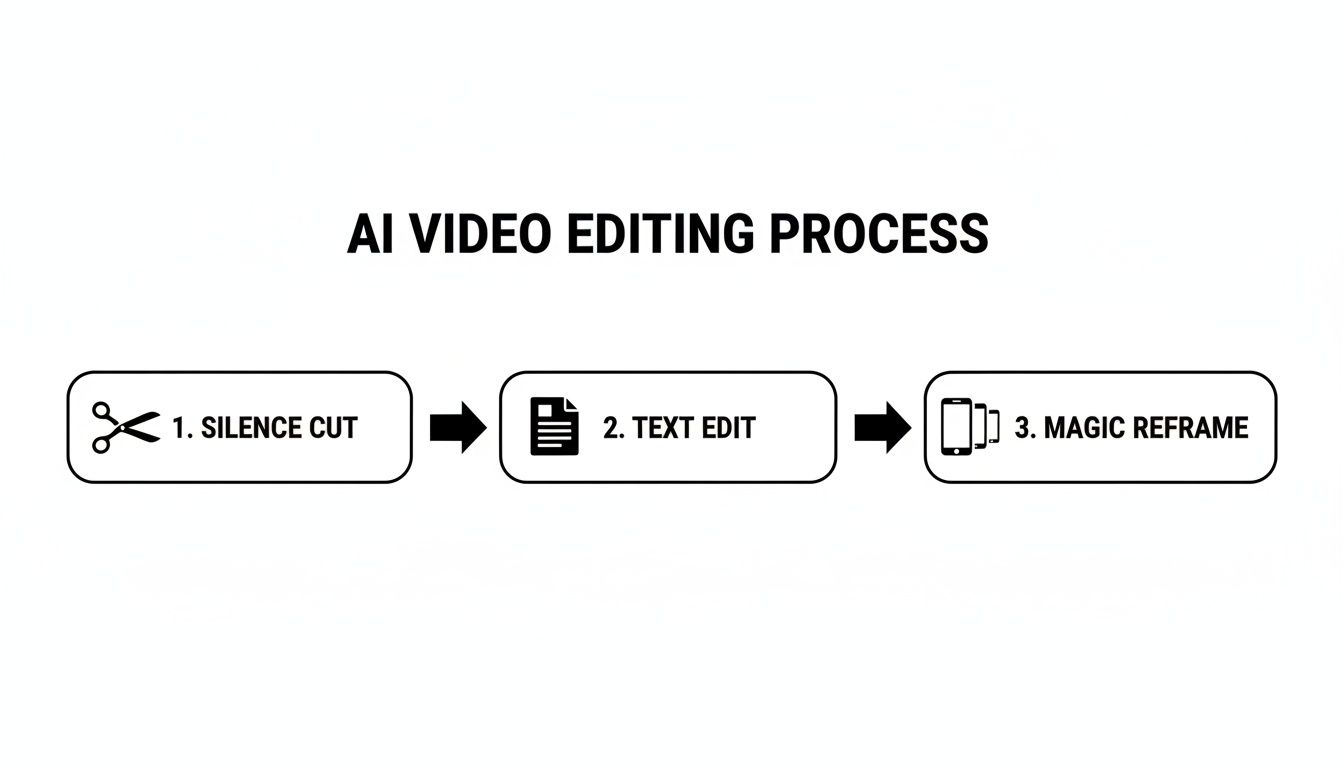
As you can see, the path from raw footage to a full suite of content gets a lot shorter when you automate the most time-consuming parts of editing. To get the most out of this, it helps to understand the basics of creating dynamic content, and you can learn more about how to make AI videos from images to broaden your skill set.
By following this workflow, you're not replacing your creativity; you're amplifying it. The AI handles the technical grunt work, which allows you to focus on being the director and strategist.
This blueprint really is the gold standard for modern business creators. It's a system designed to make producing high-quality video a sustainable and scalable part of your business. For a deeper look, check out our guide on building an effective https://tubentum.com/blog/video-creation-workflow.
The Future of AI-Powered Content Creation
Jumping into AI video editing isn't just about tweaking your workflow; it's a strategic move that gives your business a serious leg up on the competition. The market trends alone paint a very clear picture of where content creation is headed.
Right now, the global AI video editing market is valued at USD 0.9 billion (as of 2023). But by 2033, it’s expected to rocket to USD 4.4 billion. That’s a staggering 17.2% compound annual growth rate. This isn't just a fleeting trend—it's the new foundation of video production for businesses that want to stay relevant. For a closer look at the numbers, check out this in-depth analysis of video editing statistics.
This explosive growth is happening because AI is quickly moving beyond the simple stuff. We're entering a new era where AI becomes a true creative partner, not just a tool for basic cuts and captions.
Emerging AI Video Capabilities
Soon, AI will do a lot more than just polish the footage you’ve already shot. Think about these capabilities becoming standard practice for business content:
- AI-Generated B-Roll: Instead of scrolling through endless stock footage sites, you'll simply describe the shot you need for a presentation. The AI will then generate custom, brand-aligned B-roll to match your narrative perfectly.
- AI Performance Analytics: Your editor will analyze viewer data to show you exactly where people stop watching your marketing videos. It might then suggest cutting a specific segment or adding a visual element to keep your audience hooked.
- Voice Cloning and Correction: Flub a line in a training video? No need to re-record the whole take. In the near future, the AI will seamlessly correct the mistake using a perfect clone of your own voice.
The big takeaway here is that AI doesn't replace the creator. It empowers you to graduate from a tactical editor to a high-level content strategist.
By handing off the tedious, mechanical parts of production to AI, you free up your time and mental energy. You can then pour that focus into what really matters: crafting a compelling story, growing your audience, and hitting your business goals.
A platform like Tubentum isn't just a tool to solve today's editing headaches; it’s designed to be a partner in this evolution. It takes care of the technical heavy lifting, letting you stay ahead of the curve and focus on creating content that truly connects. You get to be the director, not just the editor.
Still Have Questions About AI Video Editing?
It's completely normal to have questions before diving into a new way of working. Let's tackle some of the most common ones that creators and businesses ask when they're thinking about adding AI to their video workflow.
Here are a few quick answers to get you started.
| 1. Will AI replace human video editors? |
| For business content, AI is a powerful assistant, not a replacement. It handles the 80% of repetitive work (like cutting silences and filler words), freeing up human editors to focus on the 20% that requires creative strategy and storytelling. |
| 2. Is AI editing difficult to learn? |
| Not at all. Platforms like Tubentum are designed for business users, not just professional editors. Our text-based editing is as intuitive as editing a document, making it accessible to anyone on your team. |
| 3. Does AI work with any type of video footage? |
| AI performs best with high-quality source material. Clear audio and well-lit video will yield the most accurate transcriptions and edits. While it can improve lower-quality footage, starting with good material is always recommended for professional business results. |
Hopefully, that clears a few things up. The main takeaway is that AI is here to make your job easier, not to take it over. It's about working smarter, not harder, to achieve your business goals.
Ready to stop wasting hours on tedious edits and start producing more business content, faster? Tubentum is your shortcut to a smarter workflow. See how our AI can automatically remove silences, cut filler words, and get your videos ready in a fraction of the time. Start your free trial at tubentum.com today.