In the competitive world of content creation, simply hitting "record" isn't a strategy. To capture attention, drive meaningful engagement, and achieve tangible business outcomes, creators and businesses must move beyond basic production and adopt a systematic approach. This requires a deep understanding of proven video marketing best practices that transform content from just another upload into a powerful asset. This guide provides a comprehensive blueprint, offering actionable steps for every stage of your video workflow, from initial concept to final analysis.
We will bypass generic advice and dive directly into the tactical details that separate successful channels from the rest. You'll learn how to craft irresistible hooks, structure compelling narratives, and optimize your production for clarity and impact. We'll also explore how to streamline your post-production with intelligent editing techniques, such as automatically removing silences and placing hooks for maximum retention. Tubentum provides the perfect shortcut to achieving this polished, professional state without the manual effort. Furthermore, we will cover critical strategies for distribution, SEO, and repurposing content to maximize its reach and lifespan.
This listicle is designed for creators and businesses who need a repeatable system for producing high-impact video without getting bogged down in cinematic editing theories. Our focus is on practical, business-driven results. While many resources cover general video marketing best practices, this guide is specifically tailored to the needs of talking-head creators, coaches, and consultants who use platforms like YouTube to build authority and drive growth. Let's explore the ten core pillars of a successful video marketing strategy.
1. Nail the First 3 Seconds: The Art of the Irresistible Hook
In today's fast-paced digital landscape, the first three seconds of your video are not just an introduction; they are an audition for your viewer's attention. With endless content competing for every click, failing to immediately signal value is the fastest way to lose an audience. This is one of the most crucial video marketing best practices because it directly combats declining attention spans and determines whether your video gets watched or skipped.
A powerful hook is a strategic promise. It must instantly answer the viewer's subconscious question: "What's in it for me?" For business videos, this means defying traditional narrative structure. Instead of building up to a conclusion, you present the most valuable, shocking, or intriguing part of your message right at the start.
How to Craft a Compelling Hook
Implementing an effective hook requires a shift in your scripting and editing process. Your goal is to create an "information gap" that makes the viewer curious enough to stay.
- The "Cold Open" Result: Start by showing the final, impressive result. For a tutorial, this could be the finished product. For a business case study, it might be a slide showing a 300% ROI. You hook them with the destination before explaining the journey.
- The Bold Statement: Open with a controversial or counterintuitive claim related to your niche. For example, "Your entire content strategy is wrong, and I'll prove it in the next five minutes."
- The Provocative Question: Ask a direct question that speaks to a major pain point. For a marketing consultant, this could be: "What if you could cut your ad spend in half while doubling your leads?"
The Strategic Advantage of a Strong Hook
A well-crafted hook does more than just keep people watching. It signals to platform algorithms, like YouTube's, that your content is engaging from the very beginning. Higher initial retention rates lead to better algorithmic promotion, increasing your video's reach and impact.
Key Insight: Your hook isn't just the first line of your script; it's often a separate, high-impact clip you place at the very beginning of your edit. It sets the tone and makes a promise that the rest of your video must fulfill.
Tools like Tubentum are designed around this business-critical principle. Its automated editing can identify the most engaging moments in your raw footage and strategically place them as a "preview hook" at the start, providing a shortcut to maximum impact without manual effort. This makes it an indispensable practice for any creator serious about growth.
2. Tell Compelling Stories with Emotional Connection
While data and features are important, it's emotion that drives decisions and builds lasting brand loyalty. Telling compelling stories allows you to connect with viewers on a human level, moving beyond a simple transactional relationship. This approach is a cornerstone of modern video marketing best practices because it transforms your brand from a faceless entity into a relatable protagonist in your audience's journey, boosting brand recall and encouraging organic sharing.
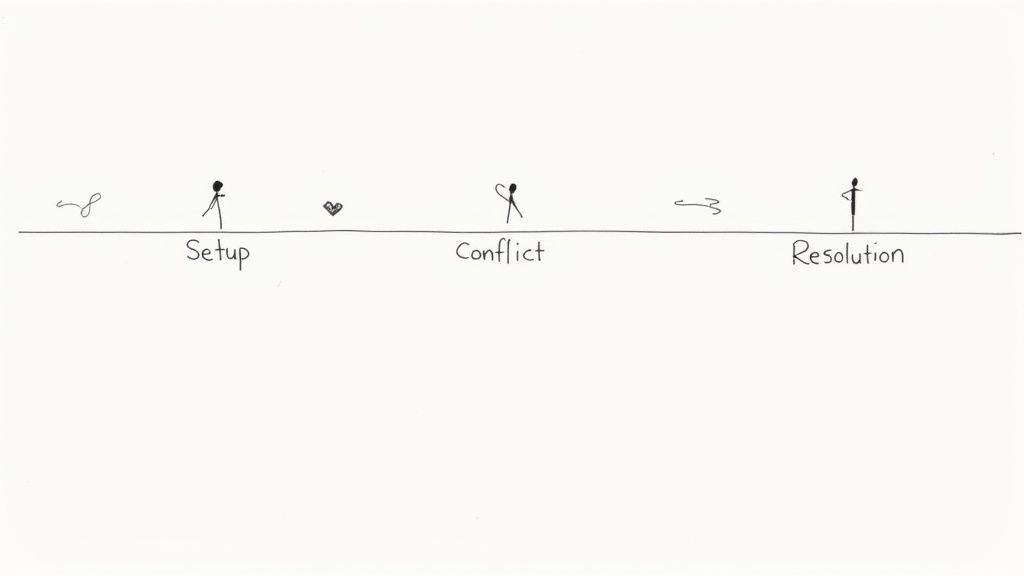
A story-driven video focuses on a narrative arc: presenting a relatable character or problem, introducing a conflict, and guiding the viewer to a resolution. This structure is far more memorable than a list of product benefits. For businesses, this can be a customer success story or a "founder's journey" narrative that taps into universal experiences like perseverance, associating those powerful feelings directly with the brand.
How to Craft an Emotional Narrative
Integrating storytelling doesn't require a Hollywood budget; it's about structuring your business message to create an emotional journey for the viewer, even in a simple talking-head video.
- Start with the 'Why': Frame your video around a core pain point or desire your audience feels. Begin with the problem, not your solution. For example, instead of "Our software has X features," start with "Are you tired of spending hours on manual data entry?"
- Show, Don't Just Tell: Use customer testimonials or case studies as your narrative. Let a real person be the hero of the story, with your product or service acting as their guide or tool that helped them succeed.
- Create a Relatable Arc: Structure your script with a clear beginning (the problem), middle (the struggle and journey to find a solution), and end (the successful outcome). This simple narrative keeps viewers engaged to see the resolution.
The Strategic Advantage of Storytelling
An emotional connection makes your message stick. Viewers who feel understood and validated are more likely to trust your brand, remember your message, and become advocates. This is especially potent for consultants and coaches, whose success is built on trust and personal connection. A well-told story can communicate expertise and empathy more effectively than any resume.
Key Insight: The most powerful stories often come directly from your audience. Your role is to be the director, finding these authentic narratives and giving them a platform. The story is the vehicle; your brand is the destination.
Even without dedicated storytellers on your team, you can build powerful narratives. Tubentum offers a shortcut by analyzing long-form footage, such as client interviews or webinars, and identifying the most emotionally resonant clips. This allows you to quickly extract powerful soundbites and build a compelling story-driven video, turning hours of raw conversation into a concise and impactful narrative.
3. Include Clear Calls-to-Action (CTAs)
A video without a call-to-action (CTA) is a missed opportunity. Your content may inform and entertain, but without a clear directive, the viewer's journey ends when the video does. Strategically including CTAs transforms passive viewers into active participants, whether they are subscribing to your channel, downloading a resource, or making a purchase. This practice is essential because it provides a measurable return on your content creation efforts and builds a direct path from engagement to conversion.
A well-placed CTA serves as a bridge, guiding your audience to the next logical step in their relationship with your brand. Simply creating great content is not enough; you must explicitly tell your audience what you want them to do next. This is one of the most fundamental video marketing best practices for creators and businesses focused on generating tangible results, as it can directly increase conversions, leads, and audience growth.
How to Implement Effective CTAs
Integrating CTAs requires both verbal cues and visual reinforcement to maximize their impact. The goal is to make the desired action as clear and frictionless as possible.
- Verbal Prompts: Directly ask your viewers to take an action. For example, "If you found this valuable, hit the subscribe button and turn on notifications so you don't miss the next video."
- Visual Overlays: Use on-screen text, graphics, or animated buttons that reinforce your verbal request. A "Shop Now" button on a product video or a "Download the Free Guide" graphic with an arrow pointing to the link in the description are highly effective.
- End-Screen Elements: Leverage platform-specific features like YouTube's end screens to prominently display links to other videos, playlists, or a subscribe button, catching viewers when they are most engaged.
The Strategic Advantage of Clear CTAs
Beyond immediate conversions, effective CTAs train your audience to engage with your content consistently. When viewers know to expect a valuable next step, they are more likely to look for it. For platforms like YouTube, actions like subscribing, liking, and commenting are positive engagement signals that can boost your video's visibility in the algorithm. A clear CTA doesn't just benefit you; it enhances the viewer experience by providing more value.
Key Insight: The most effective CTAs are placed near the end of your video, after you have delivered significant value. This ensures you're making the request when viewer trust and engagement are at their peak, making them far more likely to act.
Automated tools can enhance this strategy. For instance, Tubentum provides a shortcut to consistency by allowing users to configure branded end-screen templates with clear CTA placeholders that are automatically added to every video. This ensures you never forget this crucial element, systemizing your path from views to results.
4. Leverage Video SEO and Metadata Optimization
Creating great video content is only half the battle; ensuring it gets discovered is the other. Video SEO is the practice of optimizing your video's metadata so that platforms like YouTube and Google can understand, index, and rank it in search results. This is one of the most impactful video marketing best practices because it transforms your content from a temporary asset into a long-term lead-generation machine that works for you 24/7.
Unlike paid advertising, a well-optimized video can attract organic traffic for months or even years after publication. It directly addresses user intent by appearing as a solution when potential customers are actively searching for information. Failing to optimize your metadata is like writing a brilliant book and leaving it on a shelf with no title.
How to Implement Effective Video SEO
Proper optimization involves strategically using keywords and relevant information across all available metadata fields. Your goal is to provide clear signals to the algorithm about your video's topic and value.
- Keyword-Rich Titles and Descriptions: Start with keyword research using tools like Google Trends. Your title should be compelling and include your primary keyword. Your description should be at least 150 characters, weaving in primary and secondary keywords naturally while clearly explaining what the video is about.
- Strategic Tagging: Use a mix of broad and specific tags that are relevant to your topic. Think of what a user would type into the search bar to find your content and include those terms.
- Accurate Transcripts and Captions: Search engines crawl text. Uploading an accurate transcript or SRT file gives them a word-for-word account of your video, significantly improving their ability to understand its context and rank it for long-tail keywords.
- Compelling Thumbnails: While not direct metadata, your thumbnail is a critical SEO element. A high-contrast, clear, and intriguing custom thumbnail (1280x720px) boosts your click-through rate (CTR), a key ranking signal for YouTube. To enhance the discoverability of your videos in today's search landscape, it's crucial to leverage the latest in AI-powered search engine optimization techniques.
The Strategic Advantage of Metadata Optimization
Optimizing your metadata directly increases your video's visibility in platform search, suggested video feeds, and even Google search results. This leads to higher organic views, attracts a more qualified audience actively seeking your expertise, and builds your channel's authority over time. Learn more about how to create optimized YouTube videos to maximize your reach.
Key Insight: Video SEO is not a one-time task but an ongoing strategy. The most successful creators treat metadata with the same importance as the video script itself, understanding that discoverability is just as crucial as content quality.
While manual SEO is crucial, the process can be time-consuming. Tubentum offers a shortcut by automatically generating accurate transcripts for SEO and creating compelling short-form clips from your long-form content. Each clip can then be optimized with its own metadata, effectively multiplying your discoverability touchpoints without multiplying your workload.
5. Use Authentic and Behind-the-Scenes Content
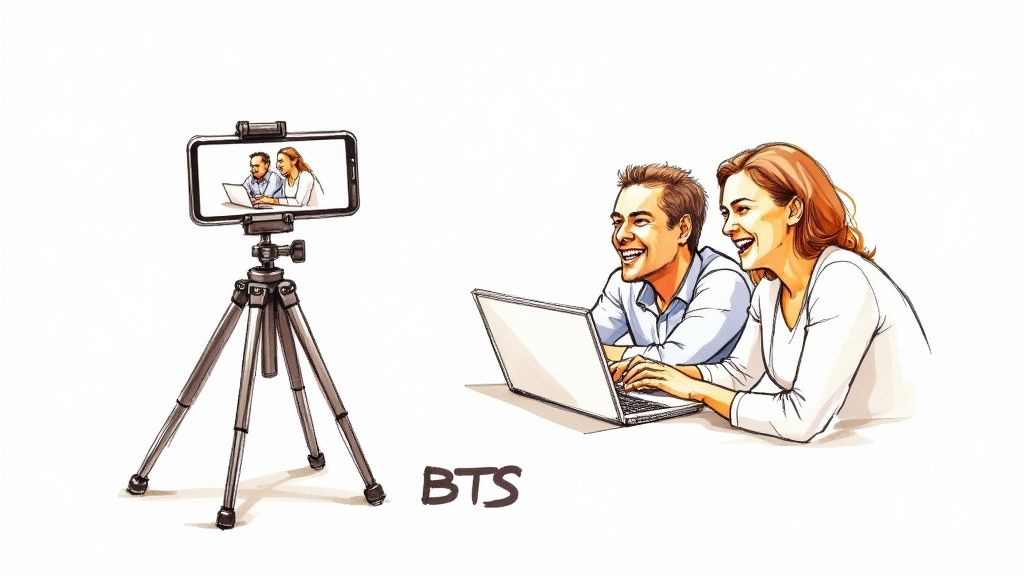
In an era of hyper-polished marketing, authenticity has become a powerful currency. Sharing unpolished, genuine behind-the-scenes (BTS) content invites your audience into your world, humanizing your brand and building a deep sense of trust. This approach is one of the most effective video marketing best practices because it shifts the relationship from a transactional one to a communal one, making viewers feel like insiders.
Audiences are growing weary of slick, impersonal advertisements. They crave connection and transparency. By showing the real people, processes, and even the occasional mistake behind your brand, you create relatable content that fosters loyalty and stands out in a crowded feed.
How to Implement Authentic Content
Integrating BTS content doesn't require a high-end production budget; in fact, a lo-fi approach often performs better. The key is to reveal the genuine side of your business.
- Show the Process: Film snippets of your creative process, like a consultant brainstorming a client strategy on a whiteboard. This provides value while building authority.
- Introduce the Team: Feature casual interviews with employees. Ask them about their roles, what they're passionate about, or a recent project win.
- Embrace Imperfection: Share moments of failure or learning. Documenting a challenge and how you overcame it is far more compelling than presenting a flawless facade.
- Use Accessible Tools: Record with a smartphone to maintain an authentic, unscripted feel. This is perfect for quick updates on Instagram Stories, TikTok, or YouTube Shorts.
The Strategic Advantage of Authenticity
Beyond building trust, authentic content is highly efficient to produce. It lowers the barrier to creation, allowing you to post more consistently and stay top-of-mind with your audience. These unpolished clips are also perfect source material for creating quick, engaging shorts and reels.
Key Insight: Authenticity doesn't mean low-quality. The audio and pacing must still be professional to hold attention. Raw footage is genuine, but long pauses and filler words will still cause viewers to drop off.
This is where automated tools become invaluable. You can film hours of authentic BTS footage and use a platform like Tubentum as a shortcut to a polished edit. It instantly removes silences and filler words ("ums," "ahs"), transforming raw, genuine footage into a tight, watchable narrative without losing its authentic charm, making this powerful strategy scalable.
6. Implement Video Analytics and Performance Tracking
Creating and publishing a video is only half the battle; understanding its performance is where real growth begins. Implementing robust video analytics and performance tracking allows you to move from guesswork to a data-driven strategy. This is a non-negotiable video marketing best practice because it provides direct feedback on what resonates with your audience, what causes them to lose interest, and what drives them to act. Without this data, you're essentially marketing in the dark.
Tracking performance is about measuring key metrics like view duration, audience retention, click-through rates, and conversions. Platforms like YouTube Analytics, Wistia, and HubSpot provide a granular look into viewer behavior, revealing the precise moments where your message connects or fails. By analyzing this feedback, businesses and creators can systematically refine their content for better results.
How to Leverage Key Video Metrics
To turn data into actionable insights, focus on the metrics that directly impact your goals. Your objective is to understand the "why" behind the numbers and use it to inform your next video.
- Analyze Audience Retention Curves: Pinpoint the exact moments viewers drop off. A steep decline in the first 15 seconds indicates a weak hook, while a dip mid-video might signal a confusing point or a lull in pacing.
- A/B Test Thumbnails and Titles: Use platform tools to test different creative combinations. Track which ones achieve the highest click-through rates to understand what visual and textual cues grab attention in your niche.
- Track Conversion Events: Don't just measure views; measure action. Use tools like Google Analytics or platform-specific features to track how many viewers click your call-to-action link, sign up for a newsletter, or make a purchase.
The Strategic Advantage of Data-Driven Optimization
Consistently analyzing video performance creates a powerful feedback loop that accelerates your content's success. It allows you to double down on formats and topics that work while quickly abandoning those that don't. This iterative process ensures your video marketing efforts become more efficient and effective with every piece of content you produce.
Key Insight: Video analytics are not just a report card; they are a roadmap for your future content. The drop-off points in your retention graph are the most valuable pieces of criticism you will ever receive, telling you exactly where your editing, scripting, or delivery needs improvement.
Analytics can reveal that slow pacing or frequent filler words are causing viewer fatigue. While this is a common issue, manually fixing it is tedious. Tubentum offers a direct shortcut to solving this problem by programmatically removing silences and "ums" and "ahs," creating a tightly-paced edit that directly addresses a key reason for audience drop-off, ensuring your analytics curves trend upwards.
7. Create Platform-Specific Content Variations
The "post everywhere" strategy is a recipe for mediocrity. Simply uploading the same 10-minute horizontal video to YouTube, Instagram, and LinkedIn ignores the fundamental differences in platform culture, algorithms, and audience expectations. This is why creating platform-specific variations is one of the most impactful video marketing best practices; it respects the viewer’s context and maximizes engagement by delivering content in the format they prefer.
Tailoring your content means more than just resizing a video. It involves adapting the tone, length, and even the core message to fit the platform's native environment. A deep-dive educational video that thrives on YouTube won't work as a 60-second TikTok, and a professional case study for LinkedIn requires a different narrative structure than an inspirational Instagram Reel.
How to Adapt Content for Each Platform
The key is to create one "pillar" piece of content, like a long-form YouTube video, and then strategically adapt it. This approach maintains a consistent core message while optimizing for reach on each channel.
- YouTube to Shorts/Reels/TikTok: Extract the most compelling 60-second soundbites or key takeaways from your long-form video. Add dynamic captions and quick cuts to match the fast-paced, vertical-video culture.
- YouTube to LinkedIn: Transform an educational segment into a professional insight. Frame it with a text post that speaks directly to industry pain points and business outcomes, using the video as a value-add.
- YouTube to Facebook/Instagram Feed: Create a 2-3 minute "highlight reel" of your main video. This could be a condensed tutorial or the most impactful part of a story, formatted in a square or vertical aspect ratio to optimize for mobile feeds.
The Strategic Advantage of Platform Optimization
Adapting your content signals to each platform's algorithm that you are creating native, engaging material, which is rewarded with greater visibility. Instead of one video performing moderately, you have multiple assets performing exceptionally well in their respective environments. This approach is central to an effective video repurposing strategy.
Key Insight: True repurposing isn't about duplication; it's about translation. You are translating your core message into the native language of each social platform to build a stronger connection with each unique audience segment.
Automated tools like Tubentum are the ultimate shortcut for this workflow. After editing your main video, its features can automatically identify and clip high-potential moments, add branded captions, and reformat them for vertical platforms. This dramatically reduces the manual effort required to create dozens of platform-specific variations, making a sophisticated distribution strategy accessible to any business.
8. Incorporate Interactive and Shoppable Video Elements
Watching a video used to be a passive experience, but modern platforms have transformed it into an active, engaging journey. Incorporating interactive elements like clickable calls-to-action (CTAs), polls, product tags, and even direct purchase options turns your content from a monologue into a dialogue. This is one of the most powerful video marketing best practices for driving immediate action and shortening the customer journey, often increasing engagement by 2x or more.
Interactive video bridges the gap between content consumption and conversion. Instead of asking viewers to remember a link or navigate to your website later, you give them the tools to act on their interest the moment it peaks. This creates a frictionless path from viewer to lead or customer.
How to Implement Interactive Features
Strategically placing interactive elements within your video’s narrative can dramatically increase their effectiveness. Your goal is to make interaction a natural next step, not a disruptive ad.
- Platform-Native CTAs: Use features like YouTube Cards and End Screens to direct viewers to other videos, playlists, or your website. These are non-intrusive and highly effective when placed at relevant points in your content.
- Shoppable Tags: Platforms like Instagram and TikTok allow creators to tag products directly in their videos. When a viewer sees a product they like, they can tap the tag to see its price and click through to purchase, all without leaving the app.
- Embedded Forms & Quizzes: For lead generation, platforms like Wistia allow you to embed forms directly into your video player. You can gate the rest of a high-value video behind an email submission, capturing leads at their moment of highest intent.
The Strategic Advantage of Interactivity
Interactive video provides rich data that passive content cannot. You can track exactly which elements viewers click, how they answer polls, and where they drop off. This insight allows you to refine your content and sales funnel with precision, understanding what truly motivates your audience.
Key Insight: Interactivity shouldn't feel like an interruption. The most effective interactive elements are those that add value to the viewer's experience, such as a poll that reveals community opinion or a clickable link to a resource you just mentioned.
While many interactive features are platform-specific, the core principle is universal: make your content actionable. Tubentum provides a shortcut to this goal by creating highly engaging, well-paced videos that hold attention, making viewers more likely to reach and interact with your strategically placed CTAs and end screens.
9. Leverage User-Generated Content (UGC) and Testimonials
Harnessing the voice of your audience is one of the most powerful and authentic video marketing best practices you can adopt. User-Generated Content (UGC) and video testimonials shift the focus from polished brand messaging to genuine experiences, building trust and social proof far more effectively than traditional advertising. This strategy leverages videos created by your actual customers, employees, and community members, which can generate significantly higher engagement and conversions.
The power of UGC lies in its authenticity. When a potential customer sees someone like them genuinely praising a product or service, it carries more weight than a scripted commercial. This approach turns your customer base into a volunteer marketing force, creating a library of relatable content that speaks directly to the pain points and desires of your target audience.
How to Implement a UGC Strategy
Actively encouraging and curating UGC requires a structured approach. Your goal is to make it easy for your community to participate while ensuring the content aligns with your brand values and quality standards.
- Create Clear Submission Guidelines: Provide simple instructions on what you're looking for, such as video length, orientation (vertical or horizontal), and key topics to cover. This helps maintain a degree of quality control.
- Incentivize Participation: Encourage submissions by offering rewards, discounts, or the chance to be featured on your primary channels. Businesses can run contests for the best video testimonial.
- Request and Secure Permissions: Always obtain explicit permission to use someone's content. A simple release form or digital agreement is crucial for protecting both your brand and the creator.
- Curate and Edit for Impact: Not all UGC will be perfect. Select the most compelling clips and edit them for clarity and impact. Adding brand-consistent intros, outros, and captions can elevate raw footage into a powerful marketing asset.
The Strategic Advantage of Authentic Voices
Integrating UGC and testimonials does more than just populate your content calendar; it builds a strong, engaged community around your brand. It demonstrates that you value your customers' opinions and experiences, fostering loyalty and advocacy. This authentic content is also highly versatile and can be repurposed across your website, social media, and email marketing campaigns.
Key Insight: The raw, unpolished nature of UGC is its greatest strength. Over-editing can strip away its authenticity. Focus on light touches that improve watchability without sacrificing the genuine feel of the original video.
Tubentum offers a powerful shortcut for scaling your UGC efforts. Its automated editing can quickly process multiple UGC submissions, trimming silences, adding consistent branding, and generating accurate subtitles. This allows you to turn a collection of customer videos into a cohesive and impactful campaign with minimal manual work.
10. Invest in High-Quality Production Value and Professional Equipment
In a crowded digital marketplace, the perceived quality of your video directly reflects the perceived quality of your brand. Investing in professional equipment and high production value is not about cinematic flair; it's about building authority and trust. High-quality visuals and audio signal professionalism, which can generate significantly higher conversion rates and enhance brand perception, making this one of the most impactful video marketing best practices you can adopt.
Superior production value immediately distinguishes your content from the amateur majority. Crisp audio, clear lighting, and stable cinematography tell the viewer that you are a serious professional who respects their time and attention. This is a core principle for any business using video to build credibility.
How to Improve Your Production Quality
You don't need a Hollywood budget to achieve professional results. The key is to invest strategically in the equipment that matters most for business video: clarity and polish.
- Start with the Essentials: Prioritize gear that has the biggest impact. A quality external microphone is often more important than a new camera for clear communication. Similarly, a basic three-point lighting kit can transform a standard webcam shot into a professional-looking setup.
- Stabilize Your Shots: Shaky footage is distracting and looks unprofessional. Always use a tripod for static shots, even for talking-head videos. This simple step adds an immediate layer of polish.
- Balance Quality with Authenticity: The goal is not to be overly slick or corporate. Your production should enhance your message, not overshadow it. Maintain your authentic voice while ensuring the technical delivery is clean and distraction-free.
The Strategic Advantage of High Production Value
Investing in quality production pays dividends beyond aesthetics. It builds viewer trust, increases engagement, and provides you with versatile assets that can be repurposed across multiple platforms. High-quality footage serves as a strong foundation for effective editing, allowing for clean cuts, smooth transitions, and a more engaging final product.
Key Insight: Professional production isn't just about what happens during the shoot; it's heavily reliant on post-production. A polished edit can elevate good footage to great, while a poor edit can undermine even the best-shot video.
Automated editing tools like Tubentum are the ideal shortcut for achieving this polish efficiently. It can automatically handle foundational edits like removing silences and adding dynamic pacing, which are core components of a professional feel. This frees you to focus on creative storytelling, ensuring your high-quality footage is transformed into an asset that drives business results. For a deeper dive into this final step, explore these effective video post-production tips on tubentum.com.
10-Point Video Marketing Best Practices Comparison
| Strategy | 🔄 Implementation Complexity | 💡 Resource Requirements | 📊 Expected Outcomes | Ideal Use Cases | ⭐ Key Advantages |
|---|---|---|---|---|---|
| Optimize for Mobile and Short-Form Content | Medium — fast edits, platform specs 🔄 | Low–Medium — smartphones, editors, captions 💡 | Higher completion & engagement; algorithm lift ⚡📊 | Social ads, TikTok/Reels/Shorts, rapid testing | Cost-effective reach and strong engagement ⭐ |
| Tell Compelling Stories with Emotional Connection | High — scripting & narrative production 🔄 | Medium–High — writers, actors, production crew 💡 | Deep engagement, improved brand recall and shareability 📊 | Brand campaigns, fundraising, long-form ads | Builds loyalty and memorable brand associations ⭐ |
| Include Clear Calls-to-Action (CTAs) | Low–Medium — placement & A/B testing 🔄 | Low — design assets, platform CTA tools 💡 | Direct conversion uplift; easily measurable 📊 | Product pages, lead-gen, end-of-video prompts | Clear impact on conversion and ROI ⭐ |
| Leverage Video SEO and Metadata Optimization | Medium — keyword & technical setup 🔄 | Low–Medium — SEO tools, time for transcripts 💡 | Increased organic visibility and CTR over time 📊 | Tutorials, evergreen content, channel growth | Sustainable discoverability and repurposing value ⭐ |
| Use Authentic and Behind-the-Scenes Content | Low — informal production, consistency needed 🔄 | Low — smartphones, staff time, minimal editing 💡 | Higher trust, authenticity; strong social performance 📊 | Employer branding, culture, product development updates | Builds credibility and humanizes brand ⭐ |
| Implement Video Analytics and Performance Tracking | Medium — measurement setup & interpretation 🔄 | Medium — analytics platforms, analyst time 💡 | Data-driven performance gains; improved ROI over time 📊 | Ongoing campaigns, optimization cycles, testing | Enables informed strategy and continuous improvement ⭐ |
| Create Platform-Specific Content Variations | Medium–High — adapt formats & messaging 🔄 | Medium — multiple edits, scheduling tools 💡 | 2–3× higher engagement vs. generic repurposing 📊 | Multi-platform launches, audience segmentation | Better algorithmic favor and audience relevance ⭐ |
| Incorporate Interactive and Shoppable Video Elements | High — technical integration & UX design 🔄 | High — interactive platforms, dev support 💡 | Higher engagement and direct conversions; reduced friction ⚡📊 | E‑commerce, live shopping, product demos | Enables direct purchase and richer data capture ⭐ |
| Leverage User-Generated Content (UGC) and Testimonials | Low–Medium — curation & rights management 🔄 | Low — community submissions, moderation time 💡 | Strong authenticity, higher engagement and conversion 📊 | Social proof, product launches, community campaigns | Cost-effective trust-building and social validation ⭐ |
| Invest in High-Quality Production Value and Professional Equipment | High — professional shoots & post-production 🔄 | High — cameras, lighting, crew, editing suites 💡 | Higher conversions and elevated brand perception 📊 | Premium product launches, brand films, hero content | Superior brand credibility and retention ⭐ |
Putting It All Together: Your Path to Video Marketing Excellence
We've explored a comprehensive suite of video marketing best practices, from the granular details of pre-production scripting to the high-level strategy of multi-platform distribution and performance analysis. Navigating this landscape can seem complex, but the journey to video mastery is built on a foundation of repeatable, strategic actions. The true takeaway is that successful video marketing for creators and businesses is no longer just about creativity; it's about creating a systematic, efficient, and viewer-centric production engine.
The common thread weaving through every practice we discussed, from optimizing for mobile to leveraging analytics, is a profound respect for the viewer's attention. Every second of your content must earn its place. This is why a powerful hook isn't just a suggestion, it's a necessity. It’s why crisp audio and clean lighting are non-negotiable, and why a clear call-to-action is essential to transform a passive viewer into an active lead or customer.
From Theory to Action: Your Implementation Roadmap
Mastering these concepts requires moving from passive learning to active implementation. The most impactful video creators don't just know these principles; they have built systems to execute them consistently and at scale. Your goal is to create a workflow that makes excellence the default, not the exception.
Here are your immediate next steps to turn these insights into tangible results:
- Audit Your Last Three Videos: Go back and analyze your recent content through the lens of this article. Where did you excel? Where are the biggest opportunities for improvement? Was your hook strong enough? Was your pacing dynamic? Was your CTA clear and compelling? This self-assessment is the fastest way to identify your specific growth areas.
- Prioritize One Key Improvement: Don't try to overhaul everything at once. Choose one or two of the video marketing best practices that will have the most significant impact on your goals. If your watch time is low, focus intently on your scripting, hook, and editing pace. If engagement is lacking, prioritize storytelling and interactive elements.
- Systematize Your Workflow: The secret to consistent quality is a solid process. Create checklists for your pre-production (scripting, shot lists), production (lighting setup, audio checks), and post-production (editing, SEO metadata). This removes guesswork and ensures you hit every critical mark, every single time.
The Strategic Advantage of Intelligent Automation
The most significant barrier for many creators and businesses isn't a lack of ideas but a lack of time. The manual, repetitive tasks of post-production, like cutting out "ums," "ahs," and long pauses, can consume hours that could be better spent on strategy, creative development, or audience engagement. This is where embracing technology becomes a powerful competitive advantage.
By integrating automated tools like Tubentum into your workflow, you reclaim your most valuable asset: time. It provides the ultimate shortcut to a professional edit, handling the tedious work of removing filler words, trimming silences, and even strategically placing your hook for maximum impact. This automation doesn't replace your creativity; it liberates it. It allows you to focus on the high-level narrative and strategic elements that truly connect with your audience and drive business results. Adopting these video marketing best practices is your blueprint for success, and leveraging smart automation is the accelerator that will get you there faster.
Ready to eliminate tedious editing and implement these best practices with unprecedented speed? Tubentum automates the most time-consuming parts of video editing, like removing silences and filler words, so you can focus on creating high-impact content. Start your free trial at Tubentum and transform your video workflow today.